Here are a few videos of the night watch biology and chemistry teams in action. The first shows a deployment of the Reeve net, which we use to collect live animals in an unharmed state for shipboard experiments. The second shows night watch team members sorting the Reeve net catch, launching the CTD, and bringing the MOCNESS net system back on deck. Enjoy!
Tuesday, September 11, 2012

Monday, September 10, 2012
The Food Horizon
 Hello blogosphere, my name is Sophie Chu. I am part of the Chemistry team on the cruise this year. I do research in Aleck Wang’s lab and I am officially, as of a few days ago, a second year PhD student. One of my specialties is being able to eat a lot. As an expert in this field, I have taken it upon myself to answer the question you have all been wondering: what’s the food like??
 |
| Main dining area |


Above: Everyone gets their own mug and cup according to the number on their bunk (left) and the coffee maker (right)!
 |
| No picture of the breakfast spread, but here's some pizza! |
Here’s a look at the food schedule:
7:15 – 8:00 am. Breakfast! I am usually asleep during this time, but before we got into our shift schedules, I remember enjoying the plethora of foods available. Pancakes, French toast, omelettes, fried eggs, sausage, bacon, oatmeal, fruit salad. Anything you could ever want for breakfast.


Lunch is served at 11:15 – 12:00 pm. This usually consists of some type of sandwich or pasta with soup, fruit and salad. Let me just say here that there is a salad bar at every meal, though this is the place you will find me the least, mostly because it is at the end of the buffet table and I don’t usually have any space left on my plate (also I don’t like salad). FYI, the red mats underneath the plates are non-skid so our food doesn't go flying off the tables while we're trying to eat.

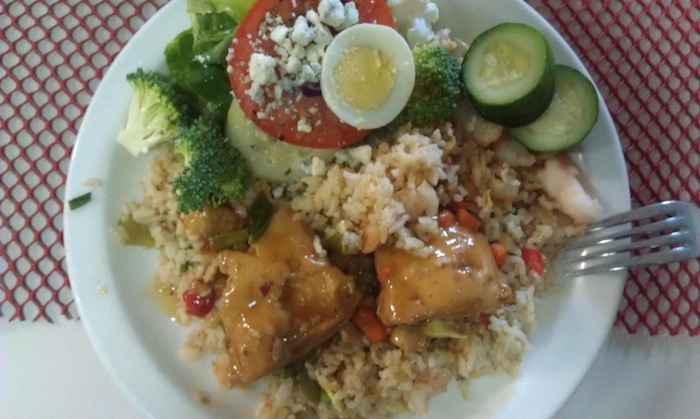

Mouthwatering aromas waft into my nostrils when deploying/recovering/sampling a CTD on deck right outside the galley before dinner, which is from 5:00 – 5:45 pm. Dinner frequently includes a succulent meat or two covered in a tasty sauce, a starch and veggies. Sunday is a special day when the meat is grilled to perfection on this baby:

 And the best part about dinner is that there is always dessert!!! Past desserts include: brownies, ice cream with fixin’s, cinnamon buns, apple turnovers, chocolate chip walnut cookies, and cake.
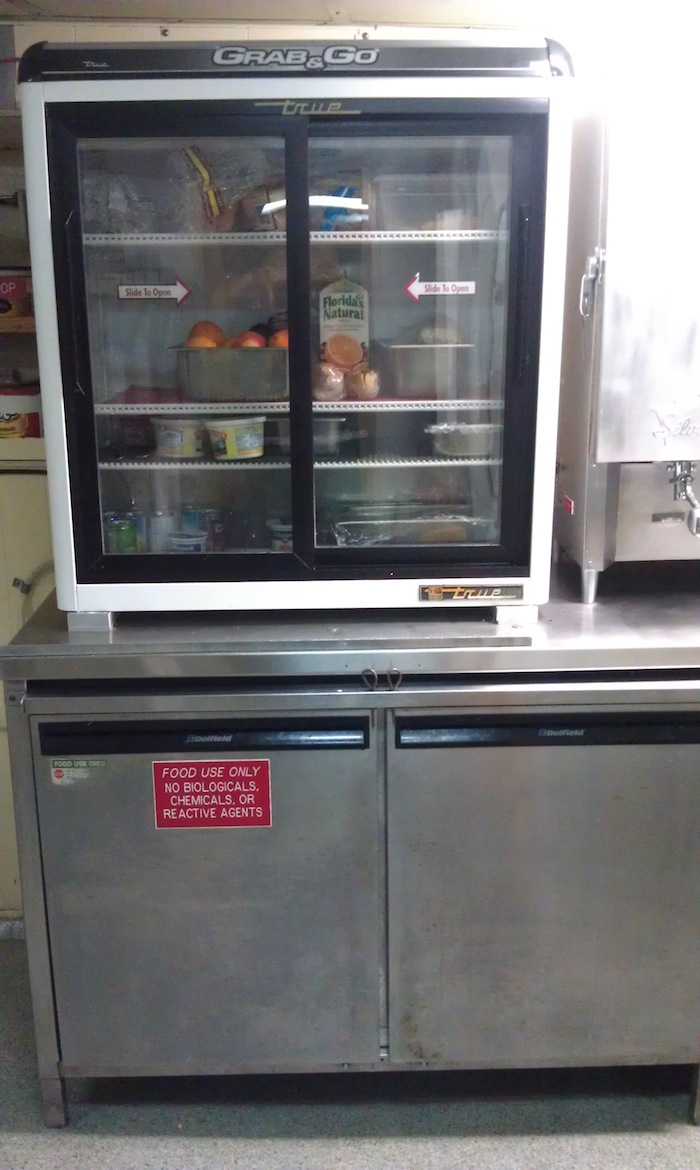 Now, just in case you need some snacks to hold you over between meals, there are copious amounts of candy, crackers, cereal, bread, fruit, yogurt, etc. available at all times. If you aren’t up for meals, you can also have someone set aside meals for you and put them in the fridge.
Leftovers from meals are also placed in the fridges (and used creatively in the next day’s meals). These foods can be used for ‘midrats’ or midnight rations to land people.


 |
| Mmmmmmmmmm. |
Phew, are you getting full from eating with your eyes yet? Ew, don’t picture eating food with your eyes. You know what I meat meant.
 |
| Thanks to Ed and Oscar! (Senior cook and cook on the ship) |
Alright folks, I hope you’ve had your fill (get it???). That’s it for now for Food on the New Horizon. Stay tuned for the next food related post with an interview from Chef Ed!
Sunday, September 9, 2012
Exercise Do’s and Don’ts on the R/V New Horizon
As you can see, science takes up most of our time on the R/V
New Horizon. However, many scientists and crew members enjoy exercising during
their time away from pteropods, CTDs, and ship driving. I’ve put together a fool-proof guide to
exercising on our ship!
DO workout
in a group! There are different workout times to accommodate your workout
preference and watch schedule! Mornings: Wisdom and weights with Nancy.
1245-1345: Hour of Pain with wrestler/boxer/MMA Willie and Captain. 1415: Kickin’ it with Kelly. 1600: Engine room trouble.
 |
| A couple of us exercising under the sun: me (Kelly) balancing on the medicine ball, Nick ready for pushups, Jack doing bicep curls, and Chumley giving the gun show. |
DO hold on
for dear life! The New Horizon likes to rock
and roll, uh, literally and figuratively! Use the rock to your advantage and exercise your stability muscles. Challenge
yourself with the roll, but be
careful not to fall overboard!
 |
| Captain getting a workout on the pull-up bar. Hold on!!! |
 |
| Willie also on the pull-up bar. Which way is up?! |
DO use the
stepper for a workout challenge! Not only will you have to survive the heat and
fumes of the deep dark engine room, you’ll be sweating bolts, not bullets, down
there!!
 |
| Sophie on the stepper sporting the 5-150 cruise t-shirt! |
DO NOT use the stepper without consulting the salty New Horizon natives. They’ll help you learn the ropes, like leaning forward on the swells, so the stepper doesn’t topple over!
DO NOT try
balancing on a medicine ball for a Women’s Health magazine “Fresh Flat Belly”
workout when there are 8 foot swells! I did, and I ended up skidding across the
0-2 level!
DO NOT hold
back!! There is nothing embarrassing about lettin go and gettin down wit
yo bad self! Dancing is a great way to exercise on a ship,
especially when you have limited room and have a hankerin to get your groove
on!! When the ship gets arollin, everyone step dances anyway!
Above all, DO
have fun! This extraordinary group of sailors and scientists all foster a
positive working and working out environment.
Friday, September 7, 2012
The Mystery Machine and the Storage Van
Amy here,
Checking in with an update on life in the lab van! Due to
its styling red lights, which shine out from three sides during most nights, we
have fondly dubbed the lab space on the 01 deck “the Mystery Machine” after the
Scooby Doo van. This space is a container van – similar to the ones you see on
the back of trailer trucks on the highway – but specially equipped to support
science on ships.
 |
| Looking in on Nick working in the science van on the 01 deck late at night. Photo by A. Maas |
At night (and early in the morning too!), in the glowing red
light, augmented by a headlamp and flashlight, I do my respiration experiments
(to see me in action look at my previous post about physiology). During the day,
when it is less disruptive to the night vision of the ship’s navigators, I
switch to normal lights and enjoy my view of the sea. To support my work we
have hooked the van into the ship’s salt water, fresh water and electricity.
Inside the van I have a water heater to make hot tap water for washing jars, a microscope
for examining pteropods, a refrigerator to keep water chilling for my animals,
gasses to change the oxygen and CO2 in my experimental water, as well as a
liquid nitrogen tank and a freezer to keep samples in. We also have a heater
and an air-conditioner to ensure that wherever we go, the space is a comfortable
temperature.
 |
| The water heater (green arrow), which joins up with the tap and the salt water line (yellow arrow) in the sink, the refrigerator (blue arrow), freezer (red arrow) salinometer (orange arrow), and fumehood (purple arrow) take up one wall of the lab van. Photo by L. Blanco Bercial and A. Maas |
 |
| My lab space has two waterbaths (green arrow), the one on the left to keep animals and experimental water cold and the one on the right to keep my electrode (red arrow) at the proper temperature. The electrode is hooked up to a meter and computer (orange arrow) where I read the measurements. To the right of the area is a jug of water that I have filtered to remove practically everything but salt from my water (blue arrow). On the left is the liquid nitrogen dry shipper (purple arrow) that lets me quickly freeze my animals for later measurements of their gene expression. The clear lines that are hanging down (black) are hooked up to gas tanks which are way down at the other end of the van. Photo by L. Blanco Bercial and A. Maas |
The temperature in the Mystery Machine needs to be pretty
constant because the salinometer is also in the van and is relatively
temperature sensitive. Once the chemistry team collects the water from each
station they bring bottles up to the van where, one by one, they use this
machine to figure out the salt content throughout the water column and calibrate the estimates of salinity that we calculate from the CTD's measurements of conductivity.
 |
| Nick running salinity samples in the van. Photo by A. Maas |
Liza’s shell work (see her previous post!) is also done in
the van. She uses the microscope up here to sort, clean and identify her
pteropods, then she carefully puts them in the fume hood, safely protected with
plastic wrap, to let the shells dry. The fume hood and the plastic wrap are
used to minimize contamination, since Liza’s work concentrates on the isotopic
signature of the shells, and any contamination can affect the signal. This is
because the minor and trace elements she is measuring are hard to detect.
 |
| Liza examining pteropods under the microscope. Photo by P. Wiebe |
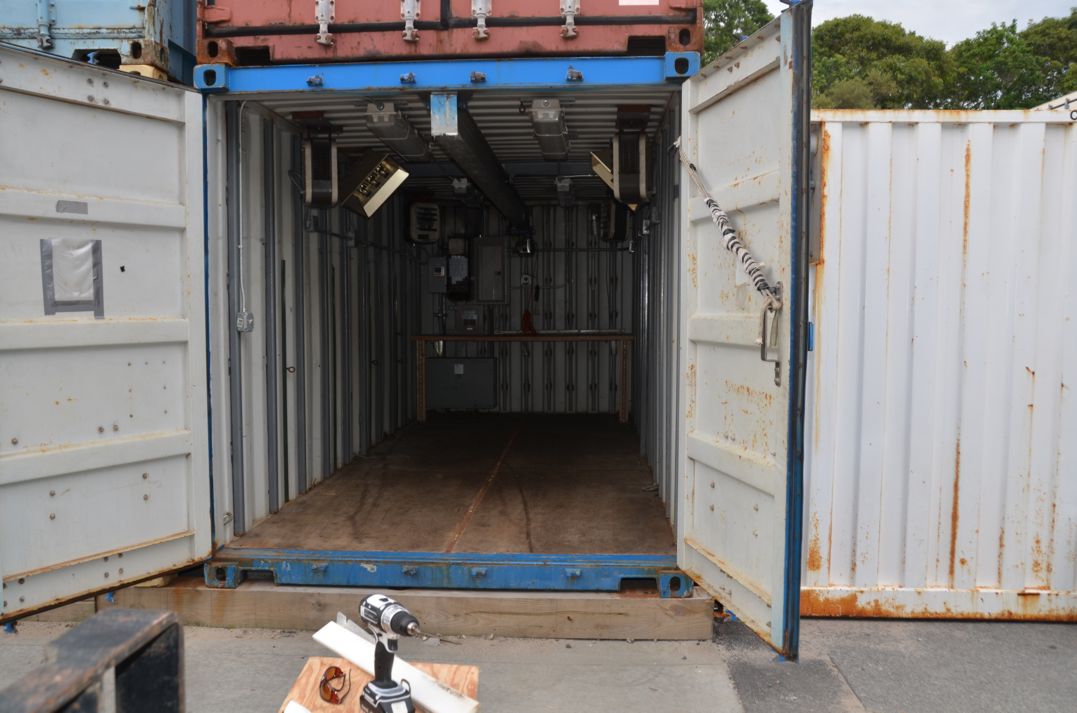 |
| The storage van in its original configuration at WHOI. The center beam supports a winch which can help move heavy equipent into and out of the van. The heaters are visible to either side at the top of the van. All of these were removed to make space for shipping our gear. Photo by P. Wiebe. |
 |
| The storage van just before the doors were closed and we sent it across country. We were surprised by how much "extra" space we had in the end. My favorite part is the last minute chair addition (as a note I am currently sitting in this chair in the main lab - its pretty comfy!) Photo by P. Wiebe. |
 |
| Craning the storage van onto its current resting place aboard the New Horizon at the Newport dock. It takes a mighty crane to move the weight onto the boat! Photo by P. Wiebe. |
When we get back to land, we will refill the blue storage van with all of our heavy equipment, crane it off the boat, and ship it back to WHOI by truck. In about a week or so we will have all of our gear back, ready to be unpacked. The Mystery Machine is part of the UNOLS fleet pool of supplies and will pass along into the hands of some other science group - re-purposed to suit whatever needs their research requires.
In the meanwhile, my work in the Mystery Machine continues to go well. We have had lots of pteropods, and I am learning a lot about how these Pacific species respond to CO2 and O2. I am looking forward to getting back to land to weigh my animals and start doing the analysis to compare between oceans.
Thursday, September 6, 2012
How Are We Doing So Far?
This is a question that quite often comes from
those who have been following our cruise and the many facets of our work at
sea. The answer is that the cruise
is going very well now. We are at
station 16 and in 24 hours should be at station 18. To
date, we have been completing about 3 stations per day in weather that has been
very workable. We have completed 12 MOCNESS tows, 23 CTD casts, 19 VPR casts, 14
Reeve Net tows, and 7 HammarHead (broad-band acoustics) tows.

We have been fortunate to have our work area under
a very large high pressure system, so
winds over 20 knots have been almost non-existent. As a result waves and swell
have been moderate, although the very strong low pressure center over Alaska,
the remnant of Typhoon “Saola,” could produce some large swells that we may
experience in a day or so. To anticipate the weather and make our plans for the next few stations, we frequently check a
NOAA website that provides National Weather Surface radiofax charts for the Northeast Pacific and North
Pacific, which is where the pressure
field charts shown below came from.
 |
| 24, 48, and 96 hour forecasts of the surface pressure fields over the North Pacific for 6 September 2012. The Pentagram shows approximately where we expect to be at each of these time points in relation to the large high pressure area in the eastern part of the North Pacific. |
Our primary interest is in the surface pressure
field predictions 24 to 96 hours in the future because the juxtaposition of
the lows and highs provide a good measure of the weather coming our way. Other
charts are also available that provide complementary information such as
wind-wave charts and sea surface temperatures. As is evident in the charts shown above for
48 and 96 hours, our anticipated position for those time periods should have us still under the
influence of the high and in decent working conditions. In the movie below you can see that the ship is rolling around in the swells a little more than in previous days, but overall conditions continue to be favorable.
Peter Wiebe
Tuesday, September 4, 2012
A Tour of the New Horizon
The R/V New Horizon has a variety of interior spaces, from the lower deck where the engine room and many of the berthing cabins (aka state rooms) are found, to the main deck with its labs, lounge, mess, and galley, to the 01 deck and its cabins, and finally the wheelhouse and chart room on the 02 deck. Below is a video of the mess, galley, lounge, and main lab, followed by a few photographs to give you a virtual tour of the interior of the vessel:
 |
| Third Mate Jack Purdy on the bridge. Captain's chair is in the foreground. |
 |
| The chart room, aft of the bridge. |
 |
| The steep stairs down to the 01 deck and then to the main deck. |
 |
| The 01 deck lab where Meghan and John the res techs set up shop. On the left is a -80C freezer for preserving things that need to be very cold... |
 |
| Dave Weaver the bo's'n in his locker, all the way forward. |
 |
| The laundry machines, aft of the bo's'n's locker and forward of the mess. Only use the 'express' cycle to save on water! |
 |
| Chief scientist's state room. |
 |
| Regular scientists' state room. |
Video: Robert Levine
The Video Plankton Recorder
Hello, this is Alex. Each day during this survey portion of our cruise we are deploying our Video Plankton Recorder (VPR) down to a depth of 1000 meters on 3 to 4 casts per day. The VPR is mounted below the Conductivity, Temperature, Depth sensor (CTD) rosette with its Niskin bottles used to collect seawater for chemical analysis. The VPR's strobe light can be seen flashing in this deployment video as it illuminates plankton that are then captured by an adjacent high-magnification camera.
Did you see a jelly pass in front of the descending rosette? It is too large to be fully imaged within the VPR's frame of view, though we often get partial pictures of large gelatinous organisms. Each frame is 14 X 14 millimeters and 15 frames are recorded per second. We have a computer program that automatically selects images that fit our criteria of brightness, focus, and size in order to select and save zooplankton pictures. Here are some particularly nice pictures from our casts on this cruise, including pteropods, the primary target of our research.
 |
 |
| Limacina helicina pteropods; although actual species identification can be difficult with these images, we have net samples which give us supplementary information |
 |
| A cute jelly |
 |
| An amphipod with buggy eyes |
 |
| A colorful copepod |
 |
| Beautiful blue jelly |
 |
| Fun with krill |
 |
| This chaetognath, or arrow worm, has a brood of eggs on her "hip" They are ambush predators in the plankton |
Collecting in situ images allows us to see the structure of fragile gelatinous organisms, which collapse out of water and can easily be damaged by nets. The VPR also gives us the exact location of animals in the water column, and we can couple environmental information from the CTD with the depth distribution of the animals to learn more about their habitat needs. Essentially the VPR is like an underwater microscope -- rather than using nets to bring animals up to the surface where we then look at them under a microscope, we're taking the microscope to them!
Subscribe to:
Posts (Atom)